


How to Tell if a Salmon DNA Product Is the Real Deal
about a 6 minute read · Updated November 2026A genuine salmon DNA product lists sodium DNA or PDRN in its ingredients, says the PDRN comes from salmon (usually salmon milt), and is sold through an authorised distributor with local labelling. In Australia, the safest choice is buying direct from the official ANZ distributor, such as our VITARAN 3 Step Routine Set.
The real deal check in six swipes
Real salmon DNA skincare leaves a paper trail.
 1/6
Three things, clearly stated.PDRN or sodium DNA, a salmon source, a local distributor.
 2/6
Salmon PDRN is not plant PDRN.Different sources, different ingredient story.
 3/6
Front of box, back of box.If PDRN is on the front, it belongs in the ingredient list.
 4/6
ppm is one number.The whole formula decides the look and feel.
 5/6
Too cheap is a warning sign.Check batch numbers, expiry dates and local details.
 6/6
Buy from the distributor.Exclusive ANZ distributor, stock held on the Gold Coast.
Salmon DNA skincare has gone from a niche Korean secret to something on every marketplace. That also means more copies and more products using the word PDRN without saying where it came from.
Here is how I check a product before it goes on my skin, or our shelves.
What makes a salmon DNA product the real deal?
A real salmon DNA product tells you three things clearly: that it contains PDRN or sodium DNA, that the source is salmon, and who is responsible for it in your country. If any of those three is missing, keep asking questions.
PDRN (polydeoxyribonucleotide) is a purified DNA fragment; ours comes from salmon milt.
For background, read What is PDRN? The Complete Australian Guide and our explainer on how salmon DNA is sustainably harvested.
Is salmon DNA PDRN the same as plant PDRN?
No. Salmon DNA PDRN and plant or lab grown PDRN come from different sources, and a product only counts as salmon DNA skincare if the brand says its PDRN comes from salmon.
Plant and lab grown PDRN
As PDRN has become a trend, many newer launches use plant or lab grown alternatives.
- The INKEY List describes its PDRN as derived from Artemisia capillaris.
- Round Lab describes its version as coming from Jeju camellia.
- Haruharu describes its PDRN as sourced from Damask rose callus cells.
Those are each brand's own descriptions, and a different ingredient story from salmon DNA. Every PDRN product we stock uses salmon DNA purified from salmon milt.
Side by side. Scroll sideways on mobile.
| Salmon DNA PDRN | Plant or lab grown PDRN | |
|---|---|---|
| Source | Purified from salmon milt | Plants, plant cells or lab processes, as each brand describes |
| How it is labelled | Sodium DNA or PDRN, with salmon named as the source | Often PDRN plus a plant name, or a plant extract |
| Fish allergy | Not suitable for those with fish allergies | Check each brand's own advice |
| What we stock | Every PDRN product in our range | None |
In stock and shipped from the Gold Coast. Afterpay available.
How do you read a salmon DNA ingredient list?
Look for sodium DNA or PDRN in the ingredient list, then check the packaging or brand information names salmon as the source.
Sodium DNA
On many Korean labels you will see Sodium DNA, which is how PDRN commonly appears in an INCI (international ingredient) list. VITARAN calls its salmon PDRN CS PDRN.
Mid list is normal
Ingredients are generally listed from highest to lowest concentration, with ingredients under about 1% allowed in any order, so sodium DNA sitting mid list is normal. What should worry you is PDRN on the front but nowhere in the ingredients.
If PDRN is on the front of the box, it should be in the ingredient list on the back. No exceptions.
Do higher PPM numbers mean a better product?
Not on their own. A PPM (parts per million) figure tells you how much PDRN is in a formula, but the full formula decides how a product looks, feels and performs on your skin.
Real label specs are useful: VITARAN lists 5,000 ppm PDRN and 5% exosomes on its label. But supporting ingredients, texture, packaging that keeps actives fresh (like capsules) and how easily you can use it daily all matter.
Use it, finish it
A product you finish morning and night will do more for the look of your skin than a bigger number you use once a week. Be wary of ppm claims you cannot match to the label.
How do you spot fake or grey import salmon DNA skincare?
Four warning signs. Tap each one.
Fakes and grey imports usually give themselves away through price, labelling and a seller who cannot tell you where the stock came from.
A price far below the usual retail price
A price far below the usual retail price is the first warning sign.
No local importer or distributor details
Products sold properly in Australia should show who is responsible for them here.
Missing batch numbers or expiry dates
Also watch for blurry printing, spelling mistakes or packaging that does not match the brand's photos.
No answer to "where do you source this?"
If a seller cannot tell you where the stock came from, keep asking questions.
What about grey imports?
Grey imports are different: they can be genuine products resold here without the brand's approval. You cannot know how they were stored or shipped (heat and time are hard on actives), and there is no local distributor to help if something goes wrong.
Where can you buy genuine salmon DNA skincare in Australia?
Buy from the brand's authorised Australian and New Zealand distributor, so you know the stock is genuine, stored properly and supported locally.
Salmon DNA Australia is the exclusive Australian and New Zealand distributor for VITARAN, CureNex and Jeunetique. Our stock comes from the Korean manufacturers, is held on the Gold Coast and ships fast, with Afterpay and free shipping over $150.
Not sure where to start?
If you are not sure where to start, our Rejuran vs CureNex vs VITARAN guide compares the ranges, and our salmon DNA skincare FAQ answers the most common questions.
The full VITARAN routine in one box
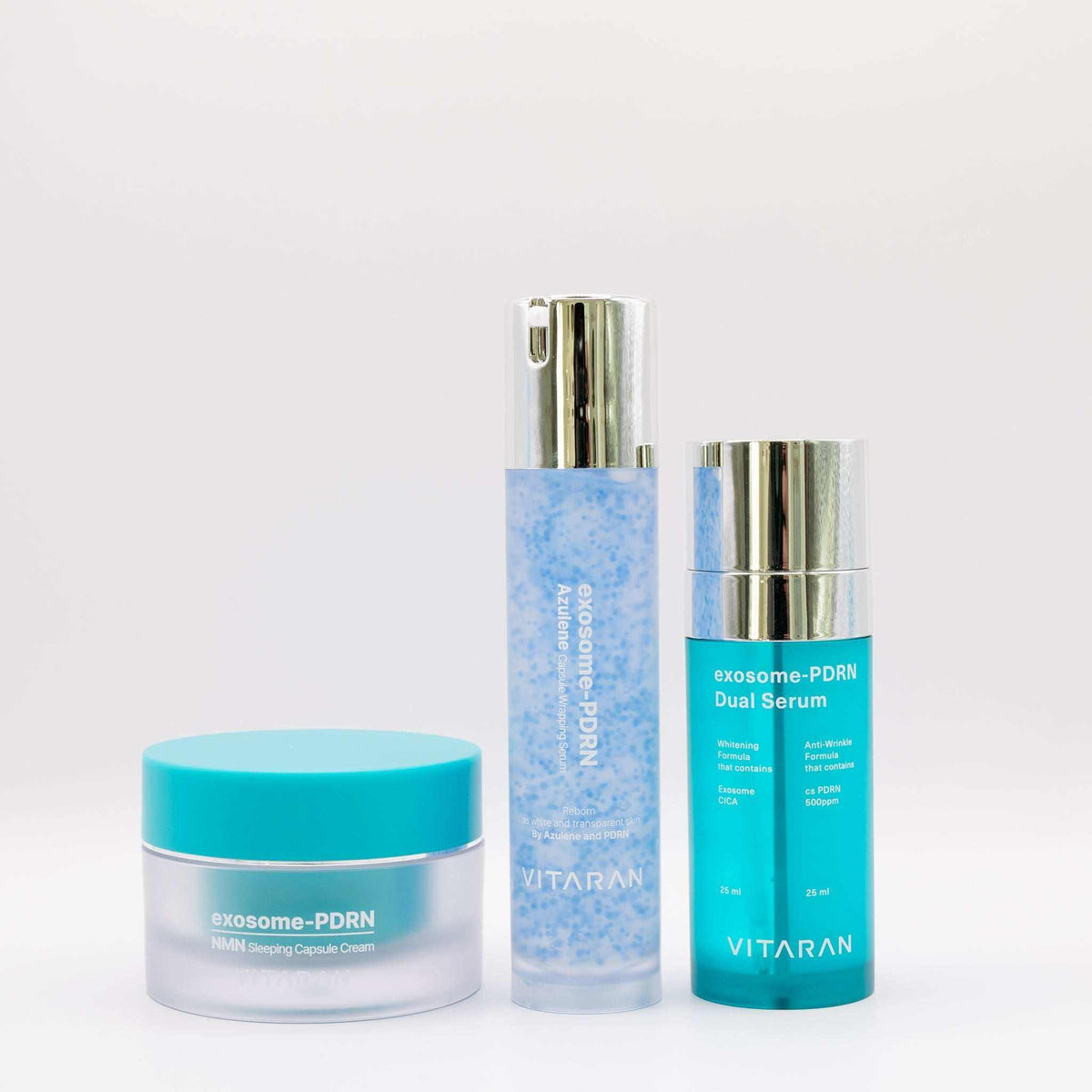
If you want the full VITARAN experience in one box, the 3 Step Routine Set brings together the Exosome Azulene Serum for mornings, the PDRN Exosome Dual Serum for nights and the NMN Capsule Cream for both. Bought separately they come to $457; the set is $369.
See the real thing
Short clips from our feed. Sound off, scroll sideways.
Real or rumour? Tap to reveal
Four buying myths. Tap a card to flip it.
 MYTH 1tap to revealIf PDRN is on the front of the box, it must be salmon DNA inside.FACT 1 · tap to flip back
Check the back, and the source.
Look for sodium DNA or PDRN in the ingredient list, then check the brand names salmon as the source. PDRN on the front but nowhere in the ingredients is a red flag.
 MYTH 2tap to revealPlant PDRN is just salmon DNA with a nicer name.FACT 2 · tap to flip back
Different source, different ingredient.
Plant and lab grown PDRN come from different sources, as each brand describes them. Every PDRN product we stock uses salmon DNA purified from salmon milt.
 MYTH 3tap to revealThe biggest ppm number always wins.FACT 3 · tap to flip back
The whole formula matters.
VITARAN lists 5,000 ppm PDRN and 5% exosomes on its label, but supporting ingredients, texture, freshness and daily use all count. Trust figures you can match to the label.
 MYTH 4tap to revealA cheap marketplace listing is just a bargain.FACT 4 · tap to flip back
Very low prices are a warning sign.
Some are copies and some are grey imports with unknown storage and no local support. Buy from the authorised ANZ distributor instead.
Genuine stock, held on the Gold Coast
Shop the VITARAN 3 Step Routine Set →4.9 star from 240+ reviews · in stock, ships fast from the Gold Coast · Afterpay availableFrequently asked questions
The questions in our DMs every week. Tap a bubble.
How can I tell if a salmon DNA product is genuine?
Check that sodium DNA or PDRN appears in the ingredient list, that the brand names salmon as the source, and that the seller is an authorised local distributor. Genuine stock also has batch numbers, expiry dates and local importer details. If a seller cannot tell you where the product came from, choose another stockist.
Is plant PDRN the same as salmon DNA?
No. Plant and lab grown PDRN come from different sources, such as Artemisia capillaris, Jeju camellia or Damask rose callus cells, as those brands describe them. Salmon DNA PDRN is purified from salmon milt. Every PDRN product Salmon DNA Australia stocks uses salmon DNA, so it is not suitable for anyone with a fish allergy.
What is PDRN called on an ingredient list?
PDRN is often listed as sodium DNA in the ingredient list, and some brands add their own trade name, such as CS PDRN in VITARAN. Ingredients are generally listed from highest to lowest concentration, so an active sitting mid list is normal. Make sure the brand also names salmon as the source.
Does a higher PPM mean better salmon DNA skincare?
Not by itself. PPM tells you how much PDRN is in the formula, but supporting ingredients, texture, freshness and how consistently you use it all shape how skin looks and feels. Trust ppm figures that match the label, like the 5,000 ppm PDRN and 5% exosomes VITARAN lists, rather than unverified claims.
Are cheap salmon DNA products on marketplaces fake?
Not always, but very low prices are a warning sign. Some are copies and some are grey imports, which may be genuine but were resold without the brand's approval, with unknown storage and no local support. Look for local distributor details, batch numbers and expiry dates before you buy.
Where can I buy authentic salmon DNA skincare in Australia?
Buy from an authorised distributor. Salmon DNA Australia is the exclusive Australian and New Zealand distributor for VITARAN, CureNex and Jeunetique, with stock held on the Gold Coast, fast Australian dispatch, Afterpay available and free shipping over $150. That way you know your products are genuine and stored properly.
Why trust this
Written by Sam Thompson, founder of Salmon DNA Australia and exclusive Australian and New Zealand distributor for CureNex and VITARAN.
Sources · background reading on the PDRN ingredient in general. These papers are not studies of our products, and our cosmetics make no medical claims.
- Squadrito F, Bitto A, Irrera N, et al. Pharmacological Activity and Clinical Use of PDRN. Frontiers in Pharmacology, 2017; 8: 224. doi.org/10.3389/fphar.2017.00224
- Kim ST. Comparison of Polynucleotide and Polydeoxyribonucleotide in Dermatology. Pharmaceutics, 2025; 17(8): 1024. doi.org/10.3390/pharmaceutics17081024

Disclaimer: these are cosmetics, not therapeutic goods, and are not intended to diagnose, treat, cure or prevent any disease or condition. Individual results vary. Always patch test; not suitable for those with fish allergies.


